E-mail: [email protected] Whatsapp: +8613647327093 Tel: +86-731-8403-0163
E-mail: [email protected] Whatsapp: +8613647327093 Tel: +86-731-8403-0163
1. What Is Sediment at the Bottom of a Rotary Drilled Pile Hole?
During the construction of rotary drilled cast-in-place piles, a rotary drilling rig continuously cuts and breaks the ground formation using a drilling bucket, removing soil, sand, gravel, and rock cuttings from the borehole.
At the same time, when slurry is used for borehole stabilization, a certain amount of drilling slurry remains inside the hole. During drilling, fine soil particles and cuttings may remain suspended in the slurry, while some larger particles gradually settle toward the bottom of the borehole.
When the borehole reaches the designed depth, this does not necessarily mean that the bottom is completely clean.
If drilling cuttings are not removed sufficiently or promptly, or if there is a long waiting period after drilling is completed, suspended particles may continue to settle. Eventually, a layer of sediment may accumulate at the bottom of the borehole.
2. What Problems Can Excessive Bottom Sediment Cause?
The presence of a small amount of sediment at the bottom does not necessarily mean that the pile construction has failed. In actual projects, the allowable sediment thickness is generally determined according to the pile type, properties of the bearing stratum, design requirements, and applicable local standards and project specifications.
The key question is:
What happens when the sediment thickness exceeds the allowable limit specified by the design or applicable standards?
① Reduced Pile Tip Bearing Performance
The pile tip needs to transfer the applied load effectively to the designated bearing stratum.
If a relatively thick sediment layer exists at the bottom of the borehole, it may form a loose and relatively low-strength medium between the pile tip and the bearing stratum.
Under normal conditions, the load transfer path is approximately:
Pile shaft → Pile tip concrete → Bearing stratum
The load can therefore be transferred relatively directly to the bearing stratum.
However, when excessive sediment is present, the load transfer path may become:
Pile shaft → Pile tip concrete → Sediment layer → Bearing stratum
This means that the load transfer mechanism at the pile tip has changed.
Sediment is typically composed of loose soil particles, drilling cuttings, and settled slurry materials. Its mechanical properties can differ significantly from those of the properly prepared bearing stratum.
Under pile-tip compression, the sediment layer may undergo compression, deformation, or localized disturbance, potentially reducing the effectiveness of pile-tip resistance.
② Reduced Concrete Placement Quality
Rotary drilled cast-in-place piles are commonly constructed using a tremie pipe for underwater concrete placement.
After concrete enters the borehole through the bottom of the tremie pipe, it gradually displaces the drilling slurry and forms a continuous and dense pile shaft.
If a relatively thick sediment layer remains at the bottom, the sediment may become disturbed or partially mixed with the initial concrete during concrete placement.
This may result in:
-Entrapped sediment in the concrete.
-Locally reduced concrete strength.
-Non-uniform concrete quality near the pile tip.
-Poorer contact conditions between the pile tip and the bearing stratum.
Particularly when the sediment layer is thick or borehole cleaning is inconsistent, it can be difficult for construction personnel to determine the actual condition at the pile bottom simply by observing the concrete placement process.
③ Increased Rework and Construction Costs
If inspection before reinforcement cage installation or concrete placement shows that the sediment thickness exceeds the allowable limit, additional borehole cleaning is usually required.
This means that the completed drilling operation cannot proceed directly to the next stage. Additional resources may be required, including:
-Drilling rigs or cleaning equipment.
-Slurry circulation systems.
-Operators.
-Auxiliary machinery.
-Electricity or fuel.
More importantly, additional cleaning takes up valuable construction time.
Therefore, from a project management perspective, controlling bottom sediment is not only a matter of quality compliance. It also helps reduce rework, improve equipment utilization, and control pile foundation construction costs.
Bottom cleaning is not an optional additional step in rotary drilling. It is an important part of borehole quality control.
1. Reaching the Designed Depth Does Not Mean Bottom Cleaning Is Complete
Suppose the designed pile-hole depth is 30 m.
When the rotary drilling rig reaches 30 m, this only indicates that the drilling tool has reached the designed depth. It does not necessarily mean that the bottom of the borehole has been completely cleaned.
The actual condition at the bottom may be:
The designed bottom elevation has been reached, but a layer of sediment still remains above the actual borehole bottom.
This is why rotary drilled cast-in-place pile construction generally involves a sequence such as:
Borehole Drilling → Bottom Cleaning/Borehole Cleaning → Inspection → Reinforcement Cage Installation → Concrete Placement
The designed drilling depth should therefore not be used as the only indicator of borehole quality.
Why Does Bottom Cleaning Become More Important as Borehole Depth Increases?
As borehole depth increases, the condition at the bottom can become more complicated due to:
-Continued settlement of particles suspended in the drilling slurry.
-Localized collapse or sloughing of borehole walls.
-Re-deposition of sediment after cleaning.
Bottom cleaning deserves particular attention in the following situations:
-Deep cast-in-place piles.
-Sand and silt formations that generate large amounts of fine particles.
-Formations with relatively poor borehole stability.
-Slurry-supported drilling.
-Long waiting periods after drilling.
-Projects requiring high pile-tip bearing capacity.
Therefore:
"Reaching the designed depth" solves the problem of borehole depth, while "bottom cleaning" solves the problem of bottom quality.
2. The Role of a Pile Cleaning Bucket in Removing Bottom Sediment
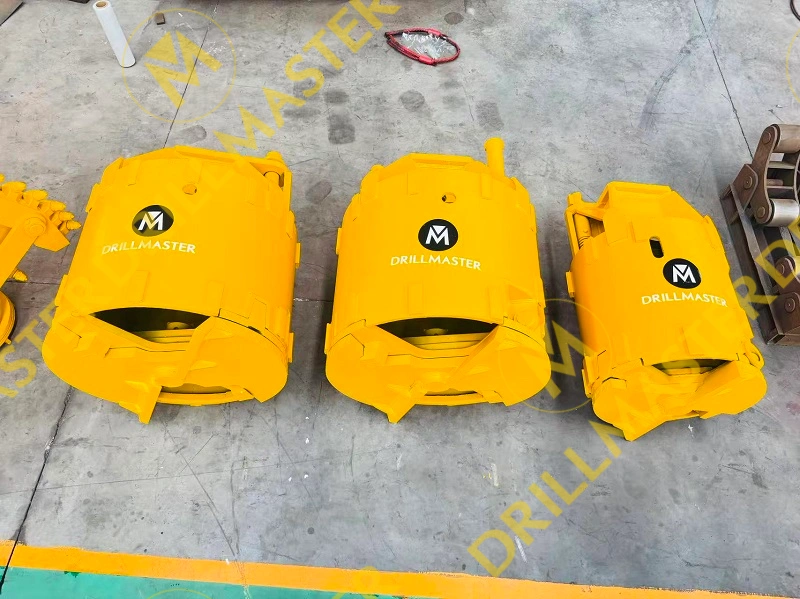
To further remove residual drilling cuttings and sediment from the bottom of the borehole, specialized cleaning tools are commonly used in rotary drilled cast-in-place pile construction.
Common English terms include Pile Cleaning Bucket, Cleanout Bucket, and Bottom Pile Cleaning Bucket.
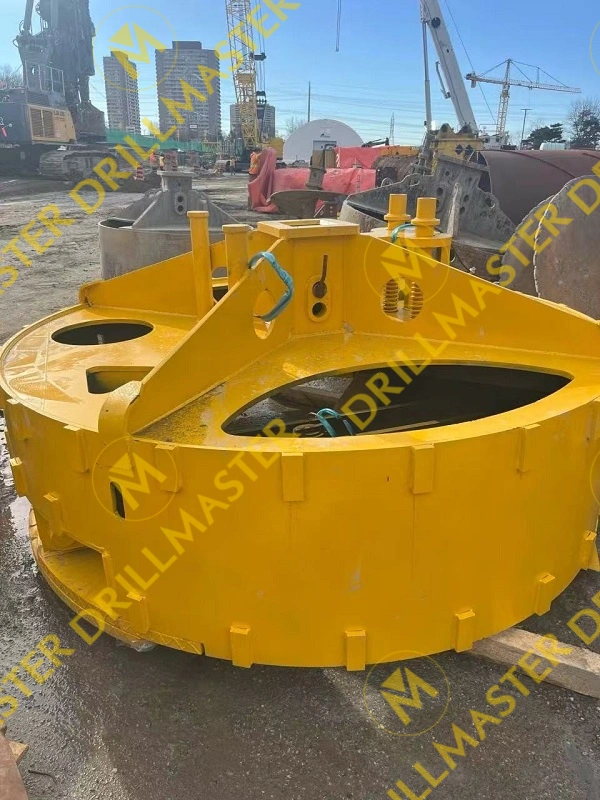
A Pile Cleaning Bucket can be understood as a specialized drilling tool designed specifically to remove sediment from the bottom of a completed borehole.
Compared with a conventional drilling bucket, a Pile Cleaning Bucket focuses more on collecting and removing bottom sediment.
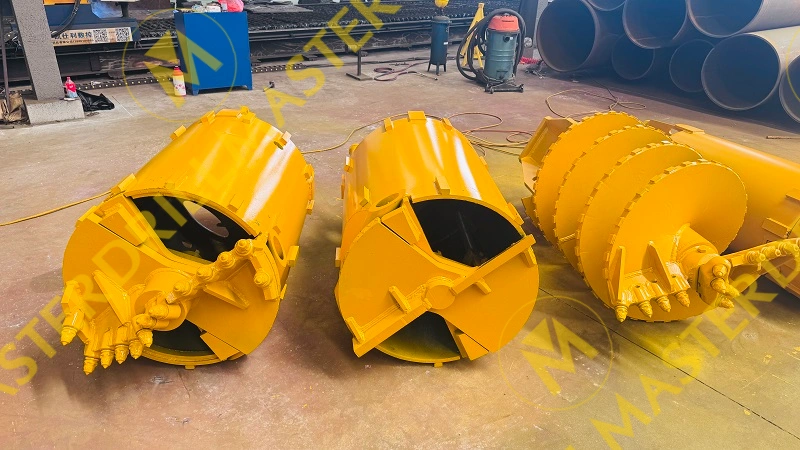
After the main drilling operation is completed, the Pile Cleaning Bucket is lowered to the bottom of the borehole. Its bottom structure, scrapers, or other sediment-collecting components allow loose sediment remaining at the bottom to enter the bucket.
The bucket is then lifted, carrying the collected sediment out of the borehole.
The basic operating process can be summarized as:
Lower the Pile Cleaning Bucket → Contact the Borehole Bottom → Collect Sediment → Lift the Bucket → Remove Sediment from the Hole
The structure of a Pile Cleaning Bucket varies according to the pile diameter, borehole depth, ground conditions, and project requirements.
For example, for different pile diameters, the outer diameter, capacity, and coverage area of the Pile Cleaning Bucket need to be considered.
For deeper boreholes, factors such as tool weight, lifting capacity, and cleaning efficiency become more important.
Different types of sediment may also require different bottom structures and sediment-collection mechanisms.
3. How Can You Determine Whether the Borehole Bottom Is Clean Enough?
This can generally be evaluated from two perspectives:
Qualitative assessment and quantitative measurement.
① Qualitative Assessment: Is There Still Significant Sediment at the Bottom?
One of the most direct methods on site is to observe the sediment brought out when the Pile Cleaning Bucket is lifted.
The following observations can provide an initial indication:
-Whether the Pile Cleaning Bucket continues to bring out significant amounts of sediment.
-Whether a large amount of sand or drilling cuttings remains inside the bucket after lifting.
-Whether the amount of sediment collected decreases significantly during subsequent cleaning operations.
-Whether obvious loose deposits remain at the bottom.
-Whether additional cleaning is necessary based on the number of cleaning cycles and construction records.
If a large amount of sediment is still removed during the first cleaning cycle, this generally indicates that considerable sediment remains at the bottom and further cleaning may be required.
After several cleaning cycles, a significant reduction in the amount of sediment collected can be used as an indication that the bottom condition has improved.
However, it is difficult to accurately determine the overall sediment thickness at the borehole bottom solely based on the amount of material removed by the Pile Cleaning Bucket or the experience of construction personnel.
The reason is simple.
The Pile Cleaning Bucket collects sediment from a limited area or within a certain collection range, while a pile borehole can have a relatively large diameter and considerable depth.
Even if the Pile Cleaning Bucket brings out only a small amount of sediment, it cannot simply be concluded that:
"There is very little sediment in the bucket = the entire borehole bottom is clean."
There may still be localized sediment, and sediment thickness may vary at different positions across the borehole bottom.
Therefore, the amount of sediment collected by the Pile Cleaning Bucket and construction experience are better regarded as qualitative field assessments and process references, rather than complete substitutes for sediment-thickness measurement.
② Quantitative Assessment: Measuring Sediment Thickness
To determine more accurately whether bottom cleaning meets the required standard, it is necessary to move from qualitative observation to quantitative measurement.
In other words, instead of simply asking:
"Is there still sediment?"
the question becomes:
"How thick is the remaining sediment layer at the bottom?"
After bottom cleaning, appropriate borehole inspection methods or measuring equipment can be used to determine the sediment thickness.
The measured results can then be compared with the project design requirements, contractual technical specifications, and applicable construction standards.
Only through this combination of cleaning and quantitative measurement can the question "When is bottom cleaning complete?" be answered more objectively.
1. What Is an Ultrasonic Borehole Probe?
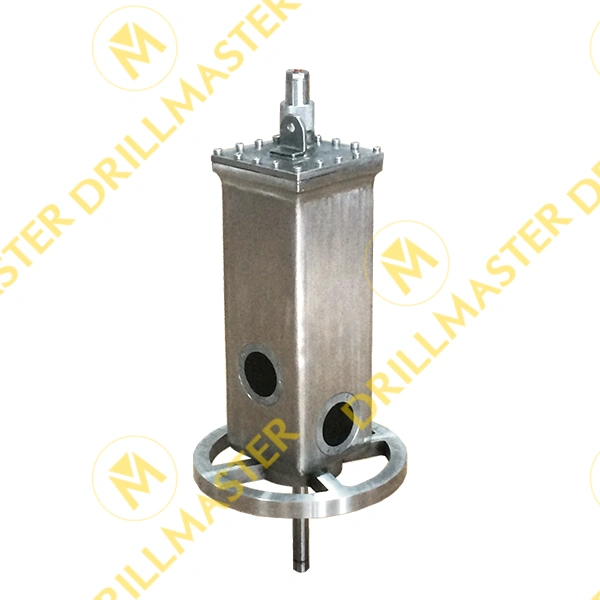
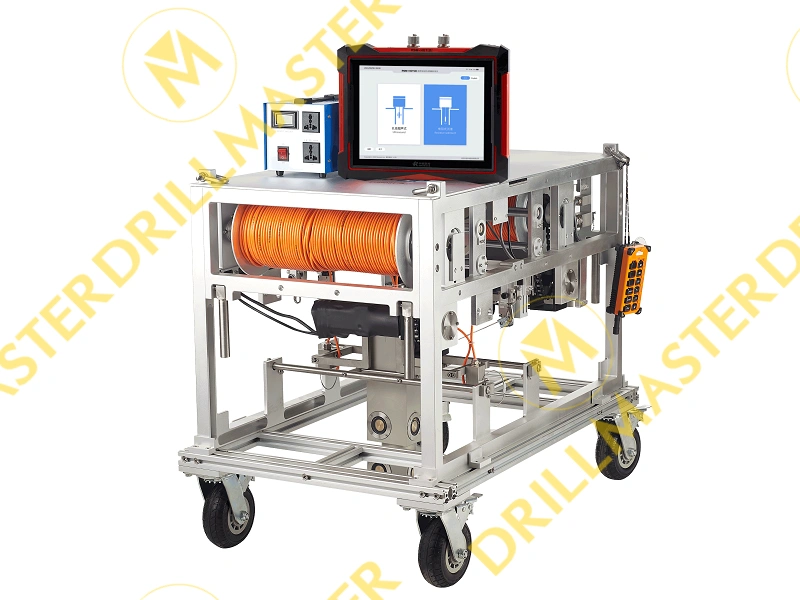
An ultrasonic borehole probe is a type of inspection and measurement equipment used for borehole or pile-hole testing.
It can transmit ultrasonic waves into the borehole through a probe and receive reflected signals to obtain relevant information about the borehole wall and bottom conditions.
2. What Is the Probe of an Ultrasonic Borehole Probe? How Does It Measure Bottom Sediment Thickness?
1) Principle of Sediment Thickness Measurement Using the Probe
Sediment thickness can be measured using a probe pressure testing method.
When the sediment probe is lowered to the bottom of the borehole, the motor automatically stops lowering the probe.
The main unit then reads the probe status. If the probe is tilted beyond a specified range, the system prompts the operator to adjust its position until the probe is approximately vertical.
The main unit then controls the probe to extend slowly while measuring the probe pressure and extension length simultaneously.
When the measured pressure reaches the specified threshold, the probe stops extending.
At this point, the probe extension length is taken as the sediment thickness at the measurement location.
3. Why Is an Ultrasonic Probe Suitable for Evaluating Bottom Cleaning Results?
① Non-Contact Inspection Can Reduce Disturbance to the Borehole Bottom
Traditional contact-based inspection methods generally require the measuring device or tool to make direct contact with the borehole bottom.
During operation, the measurement results may be affected by factors such as the looseness of the sediment, borehole depth, slurry condition, and operator technique.
An ultrasonic borehole inspection system, by contrast, primarily obtains information through the transmission and reflection of acoustic waves within the borehole medium rather than relying entirely on mechanical components to directly excavate or disturb the sediment layer.
This non-contact approach can help reduce disturbance to the original bottom condition during inspection.
② Reducing the Uncertainty of Manual Assessment
Judging whether the borehole bottom "looks clean enough" can involve a certain degree of uncertainty.
An ultrasonic probe can provide objective measurement data based on detection signals and measured results, giving construction personnel a more reliable reference for evaluating bottom conditions.
③ Providing More Intuitive Inspection Data
Another advantage of an ultrasonic probe is its ability to convert borehole-bottom conditions that are difficult to observe directly into readable and analyzable inspection data.
In other words, a condition that cannot be directly observed can be transformed, as far as possible, into quantifiable and recordable data.
This allows construction personnel to evaluate cleaning results more objectively and take timely corrective action when abnormalities are detected.
④ Helping Determine Whether Additional Cleaning Is Necessary
Bottom cleaning is not simply a matter of "the longer you clean, the better."
If cleaning is insufficient, excessive sediment may remain at the bottom.
However, if the required standard has already been achieved, repeatedly cleaning the borehole may unnecessarily increase construction time and equipment occupation.
Measurement results can therefore help determine whether another cleaning cycle is actually necessary.
⑤ Supporting Inspection Records and Quality Documentation
When inspection equipment such as an ultrasonic probe is used, the corresponding measurement results can be documented.
Depending on the equipment functions and project management requirements, records may include:
-Pile number.
-Inspection time.
-Borehole depth.
-Measured sediment thickness.
-Relevant curves or measurement data.
These records can support:
Quality Acceptance → Project Documentation → Construction Record Archiving → Quality Issue Traceability
1. Why Is Secondary Cleaning Necessary?
After the borehole has been drilled and initially cleaned (primary cleaning), new sediment can inevitably accumulate during the subsequent installation of the reinforcement cage and tremie pipe.
Time-Related Settlement
Several hours may pass between borehole completion and concrete placement.
During this period, sand and other particles suspended in the drilling slurry can naturally settle toward the bottom.
Sediment Falling from the Borehole Wall
When the heavy reinforcement cage and tremie pipe are lowered into the borehole, they may scrape against the borehole wall.
This can cause soil and sand particles to fall to the bottom.
If this newly accumulated sediment is not removed, the pile tip may effectively rest on a soft and loose layer, potentially reducing the pile's bearing performance.
2. How Is Secondary Borehole Cleaning Performed?
Secondary cleaning is commonly performed through the tremie pipe that has already been installed in the borehole.
Depending on the cleaning mechanism and source of flushing or lifting force, several methods can be used.
① Direct-Circulation Cleaning
A slurry pump forces fresh slurry through the tremie pipe to the bottom of the borehole.
The slurry carries sediment upward through the annular space between the tremie pipe and the borehole wall and returns to the surface.
This method is relatively common, but its efficiency is comparatively limited, particularly when dealing with larger sediment particles.
② Reverse-Circulation Cleaning
A common form is air-lift reverse circulation.
Compressed air is introduced into the tremie pipe to create a pressure difference and strong upward flow, rapidly lifting the bottom slurry and sediment through the inside of the pipe.
This method offers high cleaning efficiency and can provide more effective sediment removal.
It is particularly useful when dealing with relatively large sediment particles or thicker sediment layers and is considered a more advanced cleaning method.
③ Air-Lift Reverse Circulation as an Example
High-pressure air is injected into a special mixer inside the tremie pipe.
After mixing with the drilling slurry, the mixture becomes less dense and rises rapidly inside the pipe.
This creates negative pressure near the bottom of the tremie pipe, effectively drawing sediment into the pipe and discharging it through the top.
The principle is similar to a vacuum cleaner: the pressure difference generated by the air-lift system helps suck the sediment into the pipe and remove it from the borehole.
The Pile Cleaning Bucket solves the problem of:
"How do we remove the sediment?"
The Ultrasonic Borehole Probe solves the problem of:
"After cleaning, has the bottom actually reached the required standard?"
If only a Pile Cleaning Bucket is used without inspection, construction personnel may have difficulty accurately determining whether the remaining sediment thickness meets the project requirements.
On the other hand, if only inspection equipment is available without an effective cleaning method, detecting excessive sediment does not solve the problem by itself.
Therefore, combining a Pile Cleaning Bucket with an Ultrasonic Borehole Probe can create a more complete borehole-bottom quality control process.
A typical workflow can be summarized as:
Rotary Drilling
↓
Reach Design Depth
↓
Bottom Cleaning with Pile Cleaning Bucket
↓
Sediment Thickness Measurement
↓
Ultrasonic Borehole Probe
↓
Evaluate Cleaning Result
↓
Secondary Cleaning if Required
↓
Recheck Sediment Thickness
↓
Proceed to Reinforcement Cage & Concrete Placement
This creates a simple but effective principle:
The Pile Cleaning Bucket is responsible for "cleaning," while the ultrasonic borehole probe is responsible for "measuring."
Together, they help transform bottom cleaning from a process based primarily on operator experience into a more measurable and traceable quality-control procedure.
For rotary drilled cast-in-place pile construction, reaching the designed borehole depth is only one part of the drilling process.
The actual condition of the borehole bottom also needs to be controlled.
Excessive sediment can affect pile-tip load transfer, concrete placement quality, construction efficiency, and overall project costs.
A Pile Cleaning Bucket provides an effective means of removing loose sediment from the borehole bottom, while an ultrasonic borehole probe can provide measurement data to help determine whether the cleaning result meets the project requirements.
Therefore, combining bottom cleaning + quantitative inspection can provide a more complete approach to borehole-bottom quality control.
If you are looking for a Pile Cleaning Bucket for rotary drilled cast-in-place pile construction or an Ultrasonic Borehole Probe for measuring bottom sediment thickness, feel free to contact us. We can recommend suitable equipment based on your pile diameter, borehole depth, ground conditions, and project inspection requirements.
Contact Us