E-mail: [email protected] Whatsapp: +8613647327093 Tel: +86-731-8403-0163
E-mail: [email protected] Whatsapp: +8613647327093 Tel: +86-731-8403-0163
Full-length segmental casing construction is a method used in bored cast-in-place pile construction in which steel segmental casing is continuously installed from the start of drilling through pile formation to provide full-depth borehole support. The segmental casing is driven into the ground using specialized equipment, while excavation, borehole formation, and concreting are carried out under the protection of the segmental casing. The segmental casing is then removed after concreting. Its key advantages include high pile quality, effective control of complex ground conditions such as borehole collapse and necking, and no need for slurry-supported boreholes, making it particularly environmentally friendly. There are three main types of equipment used to assist with full casing construction: casing drivers, casing oscillators, and vibratory hammers.
1. Casing Driver – using thrust and rotational torque to advance the sectional casing sections down.
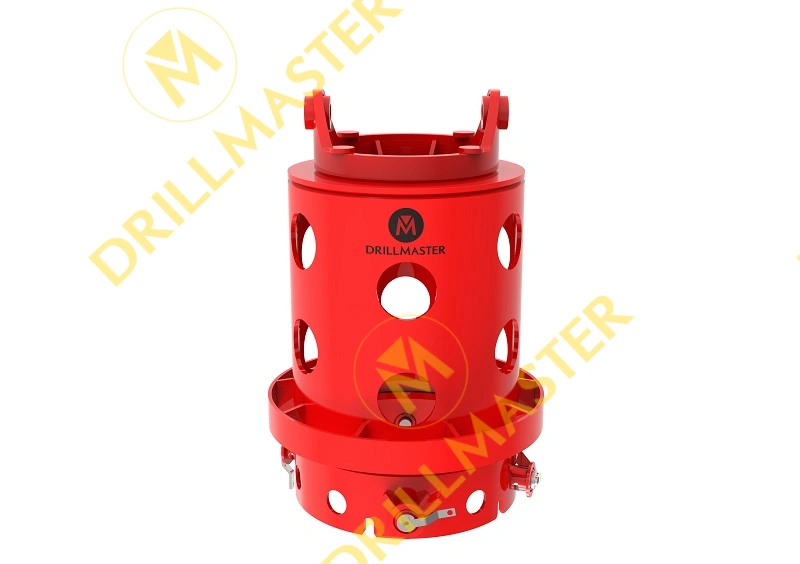
1)Working Principle
First, the equipment securely fixes the segmental casing through a dedicated connection and fastening mechanism, ensuring that the force applied by the equipment can be effectively transferred to the segmental casing. The hydraulic power provided by a rotary drilling rig or other base equipment is then used to apply continuous axial pressure to the segmental casing, allowing it to overcome the frictional resistance between itself and the surrounding soil and gradually advance into the ground. Some systems can also incorporate rotation to reduce, to a certain extent, the friction between the segmental casing and the borehole wall, making it easier for the segmental casing to penetrate the ground.
2)Advantages
① The Equipment System Is Relatively Flexible
It can typically be used together with existing foundation construction equipment such as rotary drilling rigs, meaning that a large dedicated equipment system does not necessarily need to be configured separately for segmental casing construction. Therefore, this solution can be attractive for projects with limited equipment resources or projects where construction equipment needs to be frequently relocated.
② Relatively Adaptable to Different Working Spaces
Segmental casing drivers can typically rely on existing rotary drilling rigs for operation, providing a certain degree of flexibility in equipment arrangement.
For projects with relatively confined construction sites, frequent equipment movement, or scattered construction points, this combined solution may be more convenient than using large standalone segmental casing equipment.
3)Disadvantages
① Purely Relying on Downward Pressure May Be Insufficient When High Friction or Hard Ground Is Encountered.
After the segmental casing enters the ground, friction develops between its outer wall and the surrounding soil. As the penetration depth increases, the contact area becomes larger and the frictional resistance continues to accumulate.
When encountering dense sand layers, gravel/pebble layers, or hard interlayers, the resistance acting on the segmental casing increases further. If the equipment mainly relies on axial downward pressure for penetration, the following problems may occur:
The penetration speed of the segmental casing may decrease significantly.
Repeated application of pressure may be required.
The segmental casing may still be unable to advance after the equipment reaches its rated capacity.
The segmental casing may become stuck.
Construction efficiency may decrease significantly.
② The Deeper the Segmental Casing, the Greater the Construction Resistance Generally Becomes
Equipment capacity cannot be determined based solely on the diameter of the segmental casing. The following factors must also be considered: segmental casing diameter + segmental casing length + ground conditions + frictional resistance + required downward pressure.
For deep segmental casing construction, if the equipment does not have sufficient penetration force and clamping capacity, difficulties may occur at greater depths even if the first few meters can be installed smoothly.
③ Construction Efficiency May Decrease Significantly in Complex Hard Layers
Segmental casing drivers are more suitable for directly advancing segmental casing than for forcibly penetrating extremely hard ground.
If the bottom of the segmental casing encounters a hard interlayer, dense gravel/pebbles, or rock, relying solely on downward pressure and limited rotation is often insufficient for rapid penetration.
4)Applicable Scenarios
① Relatively Soft Soil Layers
In relatively easy-to-penetrate formations such as clay, silty soil, and loose soil, the resistance acting on the segmental casing is generally relatively low.
② Projects with Relatively Limited Segmental Casing Depth
If the segmental casing only needs to penetrate toa relatively shallow depth, the cumulative friction between the segmental casing and the soil will generally not be particularly high, making it easier for a segmental casing driver to meet the requirements. Therefore, it is suitable for shallow segmental casing, temporary segmental casing, and some medium- to shallow-depth full segmental casing construction projects.
③ Small- to Medium-Diameter Pile Holes
For small- to medium-diameter pile holes, the size, weight, and penetration resistance of the segmental casing are relatively manageable, making it easier for the equipment to achieve the required clamping force and downward pressure.
④ Construction Sites with High Requirements for Equipment Mobility
If the construction site requires frequent relocation, or if the project is not suitable for deploying large dedicated segmental casing equipment, a segmental casing driver used together with a rotary drilling rig offers certain advantages. Especially for small- and medium-sized projects, construction companies with scattered work locations and limited equipment resources can use existing rotary drilling rigs for segmental casing construction, reducing additional equipment investment.
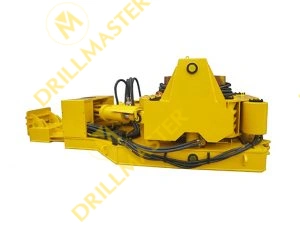
2. Casing Oscillator — Overcoming High-Resistance Casing Through “Twisting + Pressing”
1)What Exactly Is a Casing Oscillator?
A casing oscillator generally refers to a Casing Oscillator. Unlike conventional segmental casing driving methods, a casing oscillator does not continuously “press” the segmental casing downward. Instead, it uses a hydraulic system to drive the clamping mechanism, causing the segmental casing to rotate alternately forward and backward within a certain angular range while continuously applying axial pressure. This movement is very similar to “rubbing” or “twisting” something, which is why it is commonly referred to as “casing oscillation” or “casing twisting.”
What Is the Difference Between a Casing Oscillator and a Casing Rotator?
Although both Casing Oscillators and Casing Rotators can assist construction by rotating the segmental casing, their rotation methods are not exactly the same.
A Casing Oscillator mainly uses forward and reverse reciprocating rotation within a certain angular range, essentially “oscillating” the segmental casing. A Casing Rotator (full-rotation drilling rig / segmental casing rotation rig), on the other hand, mainly uses continuous rotation of the segmental casing for construction.
Simply put:
Oscillator = Reciprocating Rotation.
Rotator = Continuous Rotation.
The two differ in equipment structure, power configuration, construction methods, and applicable working conditions. Therefore, during actual equipment selection, a Casing Oscillator and a Casing Rotator should not simply be treated as the same type of equipment.
2)Why Does a Casing Oscillator Have Greater Advantages in Complex Ground Conditions?
① Reciprocating Rotation Can Reduce Friction Between the Segmental Casing and Soil
After the segmental casing enters the ground, one of the major sources of resistance is the friction between the outer wall of the segmental casing and the surrounding soil. By rotating the segmental casing forward and backward, the casing oscillator creates relative movement between the outer wall of the segmental casing and the surrounding soil, thereby reducing part of the static frictional resistance and making it easier for the segmental casing to continue moving downward.
② Simultaneously Applying Torque and Axial Force Improves Segmental Casing Penetration
A casing oscillator does not simply “rotate,” nor does it simply “press.” Its real effectiveness lies in the fact that torque helps reduce resistance, while downward pressure drives the segmental casing forward. When these two forces act simultaneously, the segmental casing can advance downward more steadily.
③ The Segmental Casing Can Advance While Drilling
In some formations, the bottom of the segmental casing may encounter harder soil, pebbles, or localized hard interlayers. If the segmental casing relies solely on its own penetration capability, difficulties in downward movement can easily occur. In such cases, the casing oscillator can drive the segmental casing while drilling tools inside the segmental casing are used for excavation or drilling.
The construction process can therefore be:
Segmental casing advancement → Internal excavation/drilling → Continued segmental casing advancement → Continued borehole deepening.
This can prevent soil and gravel from continuously accumulating at the bottom of the segmental casing and creating excessive resistance. For deep pile construction requiring full segmental casing advancement, this combination of “segmental casing advancement + internal drilling” is particularly valuable.
④ Casing Cutting Teeth Can Be Used to Further Reduce Resistance
In complex ground conditions, casing cutting teeth suitable for the formation can also be installed at the bottom of the segmental casing. When the casing oscillator drives the segmental casing to rotate back and forth, the cutting teeth at the bottom of the segmental casing cut and break up the soil in front of the casing.
In this way, the segmental casing no longer simply “pushes” against the soil, but can actively break up part of the soil through the cutting teeth at its bottom. This is also why casing oscillators often have greater advantages than equipment that relies solely on downward pressure in complex ground conditions.
3)What Are the Advantages of a Casing Oscillator?
① High Torque and Downward Pressure
When dealing with deep segmental casing, large-diameter segmental casing, or high-friction ground conditions, the equipment needs to have sufficient torque and axial penetration capacity simultaneously. A casing oscillator uses a hydraulic system to provide high torque and downward pressure, effectively handling high-resistance conditions that conventional segmental casing driving equipment may have difficulty managing. This combined power advantage becomes even more significant as the segmental casing becomes longer and larger in diameter.
② Better Adaptability to Dense Soil, Gravel/Pebble Layers, and Complex Ground Conditions
For example:
Dense sand layers.
Gravel layers.
Pebble layers.
Hard clay layers.
Alternating soft and hard formations.
Localized hard interlayers.
The common characteristic of these formations is that segmental casing penetration resistance can vary significantly, with localized sticking occurring easily.
A casing oscillator can continuously adjust the construction conditions through rotation, downward pressure, and internal drilling, giving it better adaptability than methods that rely solely on axial pressure.
③ Better Control of Segmental Casing Verticality
By clamping the segmental casing and applying relatively stable axial force, the casing oscillator can continuously control the segmental casing. Particularly in large-diameter and deep-pile construction, the segmental casing itself can serve as a guide and support structure during borehole formation, making it particularly important to maintain segmental casing verticality.
④ Low Vibration, Making It More Suitable for Urban Sensitive Environments
This is an important difference between a casing oscillator and a vibratory hammer. A vibratory hammer relies on high-frequency vibration to reduce soil resistance, allowing for fast construction, but the vibration may also propagate through the soil to surrounding areas.
If the construction site is close to:
Existing buildings.
Subway tunnels.
Underground pipelines.
Precision equipment.
Sensitive facilities such as hospitals and schools.
vibration control may become an important constraint in the construction plan. A casing oscillator mainly completes segmental casing construction through hydraulic clamping + reciprocating rotation + axial pressure and does not rely on high-frequency vibration. Therefore, it generally has greater advantages in urban environments where construction vibration needs to be controlled.
4)What Are the Disadvantages of a Casing Oscillator?
① High Equipment Investment and Supporting Requirements
Compared with simple segmental casing driving devices, a casing oscillator has a more complex hydraulic system, clamping mechanism, and power system.
At the same time, the following factors must also be considered to fully utilize the equipment's capabilities:
Main machine capacity.
Hydraulic power.
Lifting capacity.
Reaction force system.
Segmental casing specifications.
Drilling equipment.
Slurry/soil discharge system.
Therefore, if the project only involves shallow, small-diameter casing in soft soil, using a large casing oscillator may result in excess equipment capacity and a relatively low return on investment.
② Large Equipment Size and Weight
Because a casing oscillator needs to withstand high torque and axial forces, its structure is generally robust, resulting in greater equipment weight and size. This means that it generally has higher site requirements than smaller segmental casing driving equipment.
Particularly in:
Confined sites.
Sites with limited ground bearing capacity.
Projects requiring frequent relocation.
Temporary working platforms.
equipment access, lifting, installation, and relocation plans need to be considered in advance.
③ Higher Requirements for Operation and Construction Organization
Although the principle of a casing oscillator is not particularly complicated, during actual deep-pile construction, operators need to adjust the following parameters in response to changes in ground conditions:
Torque.
Downward pressure.
Oscillation angle.
Penetration speed.
Drilling speed.
Segmental casing verticality.
If the parameters are not properly matched, problems such as reduced segmental casing penetration efficiency, clamping slippage, equipment overload, or even segmental casing deformation may occur. Therefore, casing oscillator construction relies more heavily on the combined coordination of equipment selection + operating experience + construction organization.
5)What Construction Scenarios Are Suitable for a Casing Oscillator?
① Large-Diameter, Deep-Pile Construction
This is one of the most typical applications for a casing oscillator. As pile diameter and segmental casing length increase, the weight of the segmental casing and soil friction also increase, resulting in higher requirements for downward pressure, torque, and casing extraction force. At this point, the high torque and high downward pressure of the casing oscillator can be fully utilized.
② Complex Urban Environments
Urban foundation construction often faces a contradiction: the ground conditions are complex, while excessive construction vibration is not acceptable. This is exactly where casing oscillators are well suited.
They can complete segmental casing construction through mechanical oscillation and axial pressure rather than primarily relying on high-frequency vibration, giving them good adaptability in complex urban environments.
③ Construction Near Existing Buildings, Subways, and Underground Pipelines
When the pile construction point is close to existing buildings, subway lines, or underground pipelines, construction vibration and ground disturbance need to be carefully considered.
In such situations, rather than simply pursuing the “fastest casing installation,” greater attention should be paid to: segmental casing stability + construction vibration + borehole quality + surrounding environmental safety. The low-vibration characteristics of casing oscillators make them a solution worth considering for such projects.
④ Pebble Layers, Dense Sand Layers, and Hard Interlayers
These formations are often where conventional segmental casing equipment encounters the greatest difficulties. In particular, in pebble layers, the bottom of the segmental casing may be subjected to uneven resistance, while dense sand layers may generate significant side friction. A casing oscillator can use reciprocating rotation to reduce friction and combine downward pressure with cutting teeth at the bottom of the segmental casing to advance gradually, making it more suitable for such high-resistance conditions.
⑤ High Groundwater Levels and Borehole-Prone-to-Collapse Formations
In formations with high groundwater levels and loose, collapse-prone soils, one of the key purposes of full segmental casing construction is to continuously maintain borehole wall stability. A casing oscillator can continuously drive the segmental casing forward during drilling, helping to establish a more stable segmental casing support system.
⑥ Projects with High Requirements for Borehole Verticality
For important foundation projects such as high-rise buildings and large bridges, borehole verticality is often an important quality-control indicator. A casing oscillator can continuously clamp and guide the segmental casing and control its position during penetration, making it suitable for projects with high requirements for segmental casing verticality and borehole quality.
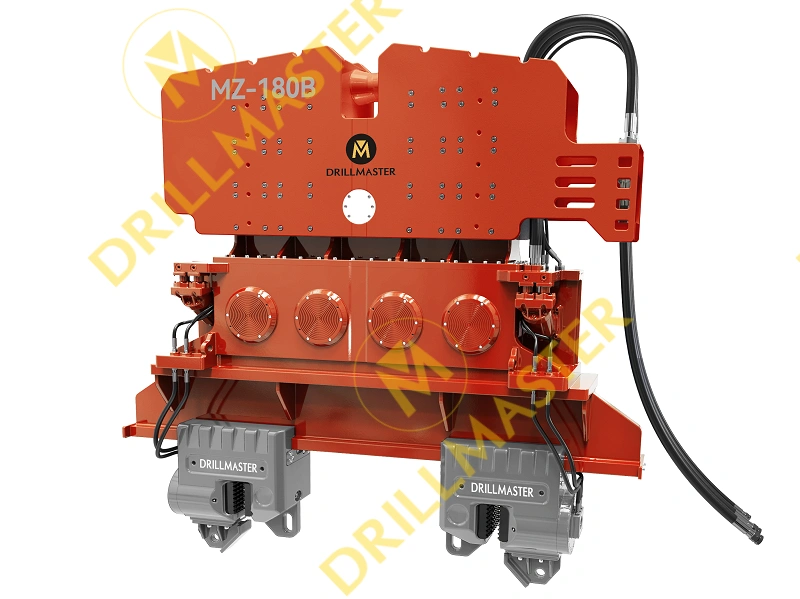
3. Vibratory Hammer — Rapidly Driving Steel Casing Through “High-Frequency Vibration” (Not Segmental Casing)
1)How Does a Vibratory Hammer Work?
① A Hydraulic Vibratory Hammer Applies High-Frequency Vibration to Steel Casing (Not Segmental Casing)
Hydraulic vibratory hammers are typically installed on excavators, cranes, or other equipment capable of providing the required hydraulic power and lifting capacity. During construction, the vibratory hammer securely clamps the steel casing through a clamp and then uses a hydraulic motor to drive internal eccentric mechanisms at high speed, generating periodic excitation forces. These excitation forces are transmitted to the steel casing through the clamp, causing the steel casing to vibrate at high frequency.
② Why Does Vibration Help the Steel Casing Sink?
When the segmental casing begins to vibrate at high frequency, the contact conditions between the segmental casing and the surrounding soil change. Under certain soil conditions, high-frequency vibration can disturb the soil around the steel casing, reducing the instantaneous resistance between the steel casing and the soil.
③ The Self-Weight of the Steel Casing Is Also an Important Downward Force
A vibratory hammer does not rely entirely on excitation force to “drive” the steel casing into the ground. In fact, the weight of the steel casing itself is an important downward force. When the steel casing is subjected to high-frequency vibration, the resistance from the surrounding soil decreases. Under the combined action of the steel casing's own weight and the additional downward pressure from the equipment, the steel casing can gradually move downward.
2)What Are the Advantages of a Vibratory Hammer?
① Fast Casing Installation
Traditional static-pressure or mechanical driving methods need to continuously overcome the friction between the steel casing and the soil. A vibratory hammer can reduce part of this resistance through high-frequency vibration, allowing the steel casing to enter the soil relatively quickly. Particularly in formations suitable for vibration construction, such as soft soil and loose sand, steel casing penetration can be very fast. For projects requiring the installation of a large number of temporary steel casings, this speed advantage can directly translate into higher construction efficiency.
② High Construction Efficiency
A vibratory hammer not only provides fast casing installation, but also has a relatively straightforward overall construction process. If the ground conditions are suitable, operators do not need to spend a long time repeatedly dealing with stuck steel casing, which can shorten the construction cycle for each steel casing.
③ Good Equipment Mobility
It can be installed on equipment such as:
Crawler cranes.
Mobile cranes.
Excavators.
Pile rigs.
Therefore, construction companies can select a suitable base machine according to project requirements. This flexibility is particularly important for projects with multiple construction points or projects requiring frequent equipment movement.
④ Good Construction Efficiency in Soft Soil and Loose Sand
A vibratory hammer is not equally effective in all ground conditions. In soft soil, loose sand, and certain formations where friction can be readily reduced, vibration can effectively reduce resistance and improve construction efficiency. Particularly in granular soils, vibration may cause soil particles to rearrange and reduce the instantaneous resistance around the steel casing, thereby improving casing penetration efficiency.
⑤ Easy Steel Casing Extraction
If the project uses temporary steel casing, casing extraction can be just as important as casing installation. After construction is completed, the vibratory hammer can re-clamp the steel casing, reduce extraction resistance through vibration, and then work together with lifting equipment to pull the steel casing upward. This can reduce the need for separate large-scale casing extraction equipment.
3)What Are the Disadvantages of a Vibratory Hammer?
① Vibration Can Propagate Through Surrounding Soil and Structures
When a vibratory hammer operates, the steel casing generates high-frequency vibration, which inevitably propagates through the soil to surrounding areas. If the construction area is open and there are no important structures nearby, this impact is generally easier to control. However, if the construction point is close to existing buildings, roads, bridges, underground structures, or other sensitive facilities, the impact of vibration needs to be carefully evaluated.
② Urban Sensitive Areas May Be Subject to Noise and Vibration Restrictions
One of the biggest challenges of urban construction is that construction equipment cannot be evaluated based solely on its own efficiency; the surrounding environment must also be considered.
For example, in:
Densely built-up areas.
Areas along subway lines.
Areas near hospitals.
Areas near schools.
Areas near precision instruments and equipment.
Areas near existing structures sensitive to vibration.
the vibration, noise, and propagation of vibration through the ground need to be carefully assessed when using a vibratory hammer. If the site has strict vibration-control requirements, a low-vibration casing oscillator or a resonance-free vibratory hammer may be more worth considering.
③ Casing Penetration Capability May Decrease Significantly in Hard Rock and Hard Interlayers
Vibratory hammers are particularly effective at using vibration to reduce soil resistance, but this does not mean they are suitable for directly breaking through extremely hard ground.
If the bottom of the steel casing encounters:
Hard rock.
Large boulders.
Hard interlayers.
High-strength soil.
the resistance-reduction effect generated by vibration may be insufficient to allow the steel casing to continue sinking rapidly.
In such cases, the vibratory hammer may continue operating while the steel casing penetration speed becomes increasingly slow. In severe cases, the steel casing may be unable to continue penetrating.
④ Strong Dependence on Ground Conditions
This is an important difference between vibratory hammers and casing oscillators. The construction efficiency of a vibratory hammer is closely related to soil properties.
The same equipment may perform as follows:
It may operate very quickly in loose sand.
Its speed may decrease in dense sand.
It may encounter difficulties in pebble layers.
It may be unable to penetrate directly in hard rock.
Therefore, actual construction capability cannot be determined simply by looking at the rated excitation force of the equipment.
The actual construction performance depends on the matching between excitation force + frequency + eccentric moment + steel casing parameters + soil properties + frictional resistance + equipment lifting capacity.
4)What Construction Scenarios Are Suitable for a Vibratory Hammer?
① Soft Soil Construction
When the soil itself has relatively low strength and steel casing penetration resistance is relatively manageable, a vibratory hammer can quickly reduce the resistance between the steel casing and the soil, thereby achieving rapid casing installation. If the project also places high demands on construction speed, a vibratory hammer is generally worth considering as a priority.
② Loose Sand Layers
Loose sand is also a typical application scenario for vibratory hammers. Vibration can cause sand particles to rearrange, reducing resistance around the steel casing and making it easier for the steel casing to move downward. Therefore, vibratory hammers can achieve high construction efficiency in certain sand and fine-sand formations. However, for very dense sand, actual performance still needs to be evaluated based on soil density and steel casing parameters.
③ Temporary Steel Casing Construction
If steel casing is used only for temporary support during drilling and needs to be removed after construction, a vibratory hammer can perform both tasks: casing installation + casing extraction. In this situation, the fast construction characteristics of a vibratory hammer can be fully utilized.
④ Projects with High Requirements for Construction Speed
If the main pressure on the project comes from the construction schedule rather than complex ground conditions or environmental vibration restrictions, a vibratory hammer often has a significant advantage.
⑤ Open Sites Where Surrounding Structures Are Not Sensitive to Vibration
Comparison Dimension One: Working Principle
Casing driver: Primarily axial penetration/mechanical driving
Casing oscillator: Torque + downward pressure + reciprocating rotation
Vibratory hammer: High-frequency vibration + self-weight/downward pressure
Comparison Dimension Two: Ground Adaptability
Soft soil: Vibratory hammers generally have higher efficiency
Medium-density ground: Casing drivers have certain advantages
Dense sand layers, pebble layers, and hard interlayers: Casing oscillators have greater advantages
Hard rock or extremely complex ground conditions: Rotary drilling, cutting teeth, and other auxiliary methods need to be combined
Comparison Dimension Three: Construction Speed
Vibratory hammer: Generally known for rapid casing installation
Casing driver: Moderate
Casing oscillator: The installation speed for an individual casing may not be as fast as that of a vibratory hammer, but stability in complex ground conditions is more important
Comparison Dimension Four: Vibration and Noise
Vibratory hammer: Vibration impact needs to be given the greatest consideration among the three
Casing driver: Relatively low
Casing oscillator: Uses torsional and axial forces and is suitable for areas sensitive to vibration
Comparison Dimension Five: Casing Diameter and Depth
Small/medium-diameter, shallow segmental casing: Casing driver
Large-diameter, deep segmental casing: Casing oscillator
Temporary segmental casing, rapid construction: Vibratory hammer
Ultra-deep, large-diameter projects: Equipment torque, clamping capacity, reaction force system, and structural strength of the segmental casing need to be carefully evaluated
It is worth noting that casing drivers and casing oscillators are used together with segmental casing, while vibratory hammers are generally used with steel casing.
Comparison Dimension Six: Equipment Investment and Construction Cost
Casing driver: Relatively flexible equipment investment
Vibratory hammer: High deployment efficiency, but lifting and supporting equipment need to be considered
Casing oscillator: Higher initial investment, but its construction stability in complex ground conditions may provide advantages in overall project costs
| Comparison Dimension | Casing Driver | Casing Oscillator | Vibratory Hammer |
| Core Principle | Penetration / Mechanical Driving | Torsion + Downward Pressure | High-Frequency Vibration |
| Soft Soil | ★★★★ | ★★★ | ★★★★★ |
| Dense Soil | ★★★ | ★★★★★ | ★★★ |
| Pebble Layers | ★★~★★★ | ★★★★★ | ★★~★★★ |
| Hard Interlayers | ★★ | ★★★★★ | ★★ |
| Construction Speed | ★★★ | ★★★★ | ★★★★★ |
| Vibration Control | ★★★★ | ★★★★★ | ★★ |
| Large-Diameter Casing | ★★★ | ★★★★★ | ★★★★ |
| Deep Casing | ★★★ | ★★★★★ | ★★★ |
| Urban Sensitive Areas | ★★★★ | ★★★★★ | ★★ |
| Equipment Investment | Low / Medium | High | Medium |
| Typical Advantage | Flexible | Powerful & Stable | Fast |
Contact Us