E-mail: [email protected] Whatsapp: +8613647327093 Tel: +86-731-8403-0163
E-mail: [email protected] Whatsapp: +8613647327093 Tel: +86-731-8403-0163
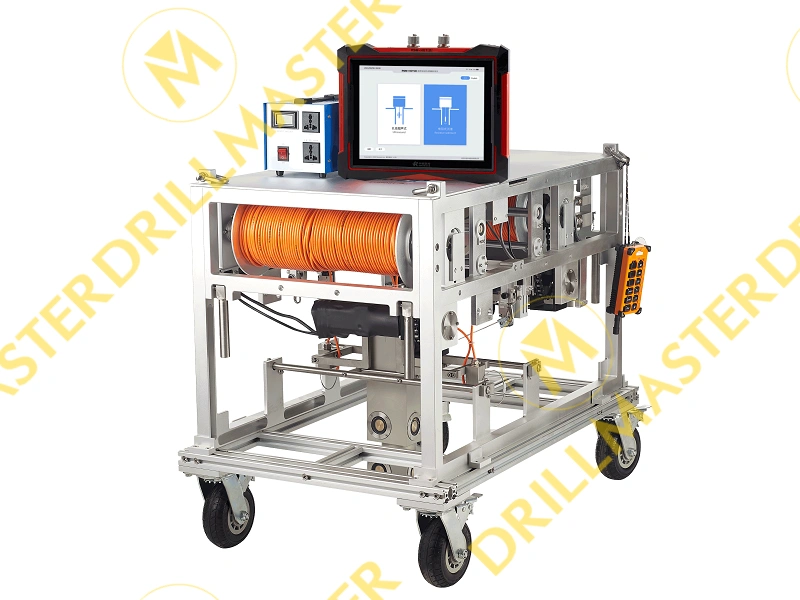
In foundation engineering projects, such as rotary bored pile construction and slurry-supported boreholes, accurate borehole measurement is essential for ensuring drilling quality and structural safety. Ultrasonic borehole testers are widely used to inspect key borehole parameters, including borehole diameter, wall profile, and verticality. These instruments transmit ultrasonic waves through the drilling slurry and receive echoes reflected from the borehole walls. By analyzing the echo travel time and sound velocity, they calculate the distance between the probe and the borehole wall to evaluate the borehole geometry.
Accurate measurement results help construction teams identify potential borehole defects, such as necking, overbreak, irregular borehole walls, and verticality deviations, before reinforcement cage installation and concrete pouring. Early detection of these issues allows engineers to take corrective measures and reduce the risk of pile quality problems.
However, even a high-performance ultrasonic borehole tester may produce inaccurate or unstable results under challenging site conditions. Factors such as slurry properties, improper sound velocity calibration, probe positioning, and irregular borehole wall conditions can affect ultrasonic wave propagation and echo detection, leading to measurement errors. Understanding these factors and applying appropriate measurement practices are therefore essential for improving data reliability, minimizing misinterpretation, and avoiding unnecessary repeated inspections.
2.1 Slurry Density and Solid Particle Content
Drilling slurry serves as the medium through which ultrasonic waves travel between the probe and the borehole wall. Its properties directly affect signal transmission and measurement accuracy. When the slurry contains excessive sand, drilling cuttings, or other suspended particles, ultrasonic waves may experience increased scattering and attenuation. This can weaken the reflected echoes, making borehole wall detection more difficult and causing unstable or missing measurement data. However, slurry density alone does not determine ultrasonic transmission quality. The concentration, size, and distribution of suspended particles must also be considered.
2.2 Slurry Viscosity and Air Bubbles
Slurry viscosity can indirectly affect ultrasonic measurement by influencing the suspension and settling of solid particles. In addition, air bubbles trapped in the slurry can scatter, reflect, and attenuate ultrasonic waves, reducing echo signal quality. Uneven slurry conditions at different depths may also cause fluctuations in measurement results, making accurate borehole profile detection more challenging.
2.3 How to Minimize Slurry-Related Measurement Errors
To reduce slurry-related measurement errors, operators should check slurry conditions before conducting ultrasonic borehole inspections. Measurements should be avoided when the slurry contains excessive suspended solids or air bubbles. If necessary, allow the slurry to stabilize or use slurry circulation and desanding equipment to improve its condition. When abnormal readings occur, repeat measurements at the affected depths to determine whether the results indicate actual borehole defects or interference caused by slurry conditions.
3.1 How Sound Velocity Affects Borehole Diameter Calculation
Ultrasonic borehole testers calculate the distance between the probe and the borehole wall based on the round-trip travel time of ultrasonic waves and the sound velocity in the slurry. If the sound velocity used by the instrument differs from the actual velocity, systematic measurement errors may occur. These errors can affect the calculated borehole diameter, wall profile, and overall measurement accuracy. Therefore, accurate sound velocity calibration is essential for obtaining reliable results.
3.2 Factors That Change Sound Velocity in Slurry
The speed of ultrasonic waves in drilling slurry can vary depending on several factors, including temperature, slurry composition, concentration, and physical properties. Slurry conditions may differ between construction sites or even at different depths within the same borehole. Using sound velocity values from previous projects without verification may therefore lead to inaccurate measurements.
3.3 Best Practices for Sound Velocity Calibration
To ensure measurement accuracy, operators should calibrate the sound velocity according to the equipment manufacturer's instructions before testing. Calibration should preferably be performed using slurry with properties similar to those in the actual borehole. If slurry conditions or temperature change significantly, the sound velocity should be checked and adjusted as necessary. For projects requiring higher precision, measurement accuracy can also be verified using a known reference distance.
4.1 Probe Centering and Alignment
The position and orientation of the ultrasonic probe inside the borehole can affect measurement accuracy. When the probe is significantly off-center, the distances to the borehole walls may vary in different measurement directions. If the instrument does not adequately compensate for probe eccentricity, this may lead to errors in borehole diameter and wall profile calculations. Probe tilting or misalignment can also affect echo detection and measurement consistency.
4.2 Probe Movement and Measurement Stability
Stable probe movement is essential for reliable ultrasonic measurements. Excessive lifting or lowering speeds may affect data collection and the distribution of measurement points along the borehole depth. Probe swinging, rotation, or contact with the borehole wall can cause fluctuations in echo signals. In addition, cable movement, equipment vibration, and unstable operation may reduce measurement repeatability.
4.3 How to Improve Probe Positioning Accuracy
Before measurement, operators should inspect the probe installation and connecting components to ensure proper alignment and stability. During testing, the probe should be raised or lowered smoothly at the manufacturer's recommended speed, avoiding sudden movements or stops. Suspicious measurement results should be verified through repeated inspections at the affected depths. For instruments equipped with multi-directional measurement capabilities, proper use of positioning, orientation detection, and data processing functions can further improve measurement reliability.
5.1 Rough and Irregular Borehole Walls
In complex geological formations, such as gravel layers and fractured rock, borehole walls may become rough and irregular. These uneven surfaces can cause ultrasonic waves to scatter or reflect in different directions, reducing the strength of echoes returning to the probe. As a result, identifying the exact borehole wall position may become more difficult. For localized protrusions or depressions, continuous measurement data at different depths should be analyzed to determine whether they represent actual wall irregularities.
5.2 Borehole Collapse, Overbreak and Necking
Borehole collapse and overbreak can cause sudden changes in the borehole wall profile, while necking reduces the distance between the probe and the borehole wall and may even obstruct probe movement. Complex wall geometries can also produce multiple echoes, making it difficult to identify the correct reflected signal. Therefore, operators should distinguish actual borehole defects from measurement abnormalities caused by ultrasonic scattering or signal attenuation.
5.3 How to Interpret Measurement Data in Complex Boreholes
When inspecting boreholes with irregular wall conditions, operators should analyze continuous measurement profiles to identify changes in borehole geometry at different depths. Comparing ultrasonic data with geological information, drilling records, and construction observations can help determine whether abnormalities indicate actual borehole defects. Conclusions should not be based on a single abnormal measurement point.
| Inspection Item | Recommended Measures |
| Slurry Properties | Check sand content, air bubbles, and slurry stability to minimize interference with ultrasonic wave propagation. |
| Sound Velocity Calibration | Calibrate sound velocity based on actual slurry conditions and verify the calibration when necessary. |
| Probe Positioning | Maintain a stable probe position and control the lifting and lowering speed. |
| Borehole Wall Conditions | Identify abnormalities by analyzing echo signal quality and continuous measurement data. |
| Data Verification | Repeat measurements at abnormal depths and compare the results with construction records. |
Acquisition calculations of a drilled excavation to determine shaft verticality, radius, and volume, with 360 degree, 2D and 3D profile views. The Data acquisition at a rate of approximately one scan per second with eight channels scanned simultaneously.
Independently developed multi-functional integrated probe with integrated hole and groove detection and sediment detection functions.
Independently developed synchronous printing host control box, real-time detection, synchronous printing, and the results are true and reliable.Seamless switching between dry hole and mud hole detection, strong adaptability.
Contact Us