E-mail: [email protected] Whatsapp: +8613647327093 Tel: +86-731-8403-0163
E-mail: [email protected] Whatsapp: +8613647327093 Tel: +86-731-8403-0163
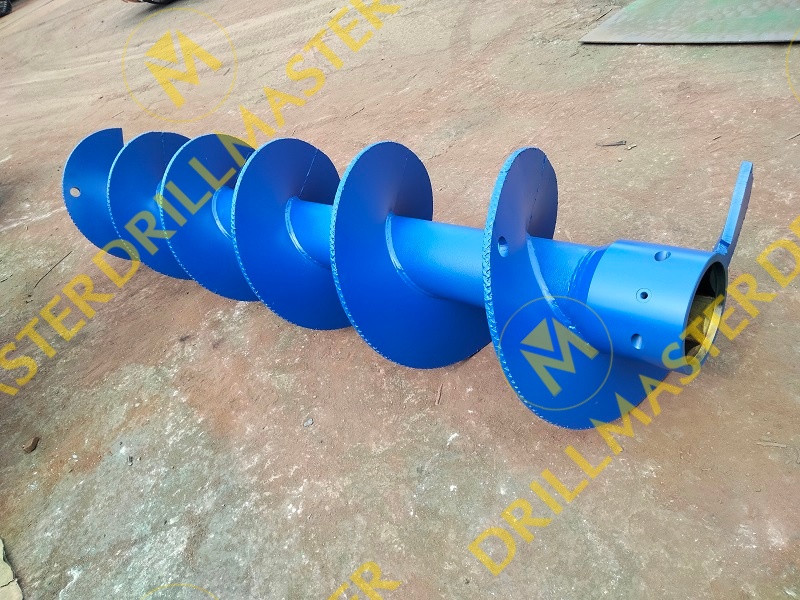
In CFA(Continuous Flight Auger) (Continuous Flight Auger) piling, concrete overbreak refers to the situation where the actual volume of concrete placed into a pile is greater than the theoretical concrete volume calculated from the designed pile diameter and length.
In practice, the ground surrounding the pile may not remain perfectly stable or maintain the exact designed diameter. Loose soil, borehole enlargement, ground displacement, excessive concrete pressure, or improper auger withdrawal can cause the actual pile cavity to become larger than the design dimensions. The additional space must then be filled with concrete, resulting in concrete overbreak.
Increased material costs
Longer concreting time
Difficulty controlling pile geometry
Potential impact on pile quality and construction efficiency
1) Loose or Unstable Ground Conditions
① Why Do Loose Ground Conditions Increase Concrete Consumption?
Loose sand, gravel, backfill, and other unstable ground conditions are prone to deformation during drilling and concrete placement. The soil around the borehole may move outward, causing the actual cavity formed during construction to become larger than the designed pile diameter.
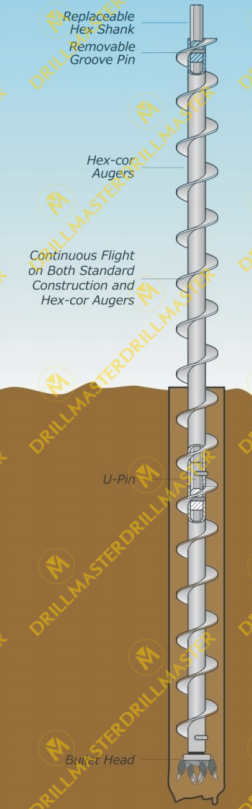
When concrete is pumped to the bottom of the pile through the hollow stem of the CFA(Continuous Flight Auger) auger, it must fill these additional spaces. As a result, the actual concrete consumption may exceed the theoretical volume.
② Which Ground Conditions Are More Likely to Cause Concrete Overbreak?
Common high-risk ground conditions include:
- Loose sand
- Gravel
- Backfill
- Soft or weak soil
- Highly weathered formations
- Water-bearing loose soils
The risk of borehole enlargement and concrete overbreak may be further increased where groundwater is abundant and the surrounding soil is easily disturbed.
③ How Can Concrete Overbreak Be Controlled in Loose Ground?
Construction parameters can be adjusted according to changes in ground conditions:
- Optimize drilling speed to reduce disturbance to the surrounding soil
- Properly control auger rotation speed
- Control concrete pumping pressure
- Adjust the auger withdrawal rate to match the concrete supply rate
- Continuously monitor actual concrete consumption and compare it with the theoretical volume
2) Borehole Wall Collapse
① Why Can Borehole Wall Collapse Occur During CFA(Continuous Flight Auger) Construction?
Although CFA(Continuous Flight Auger) construction does not require a completely open borehole to be formed in advance, as in conventional bored pile construction, the surrounding soil may still experience localized instability during drilling, pauses, and auger withdrawal.
Common conditions include:
- Localized collapse
- Soil displacement
- Borehole enlargement
- Borehole wall instability
All of these conditions can increase the actual space occupied by the pile beyond the designed dimensions, resulting in higher concrete consumption.
② What Are the Field Signs of Borehole Instability?
Borehole instability can be identified by combining construction data with field observations:
- A sudden increase in concrete consumption
- Significant differences in concrete consumption between individual piles
- Abnormal changes in drilling torque
- Difficulty maintaining the designed pile diameter
- Abnormal spoil volume or return-soil conditions
If multiple piles in the same area consistently show excessive concrete consumption, the ground stability in that area should be investigated.
③ How Can the Risk of Concrete Overbreak Caused by Borehole Collapse Be Reduced?
Construction parameters should be adjusted dynamically according to ground conditions:
- Optimize drilling parameters
- Avoid excessive drilling speed
- Maintain a reasonable and stable drilling condition
- Control concrete pressure during auger withdrawal
- Adjust construction parameters promptly according to changes in ground conditions
3) Excessive Concrete Pressure
① How Does Concrete Pressure Affect Pile Diameter?
During CFA(Continuous Flight Auger) construction, concrete is delivered to the bottom of the pile through the hollow stem of the auger and gradually fills the pile as the auger is withdrawn. If the pumping pressure is too high, it may exert additional pressure on the surrounding soil and cause soil displacement.
The effect can be simplified as:
Excessive concrete pressure → Surrounding soil displacement → Increased actual pile diameter → Increased concrete consumption
Therefore, it is important to distinguish between the normal concrete pressure required to maintain continuous placement and excessively high pressure that may cause significant soil displacement.
② What Happens If Concrete Pressure Is Too Low?
Lower pressure is not necessarily better. Insufficient pressure may result in:
- Poor concrete delivery
- Localized underfilling
- Discontinuity in the concrete column
- Difficulty maintaining continuous concrete placement
Therefore, the goal is not simply to reduce pressure, but to maintain sufficient and stable concrete pressure according to the ground conditions.
③ How Can Concrete Pressure Be Controlled?
- Monitor pumping pressure in real time
- Maintain a continuous and stable concrete supply
- Adjust pressure according to ground conditions
- Coordinate concrete pumping with the auger withdrawal process
4) Improper Auger Withdrawal Rate
① What Happens If the Auger Is Withdrawn Too Quickly?
Excessive withdrawal rate → Insufficient concrete filling → Potential voids or impact on pile integrity
Therefore, the auger withdrawal rate should not be determined solely by construction efficiency. It must also be matched to the concrete delivery rate.
② What Happens If the Auger Is Withdrawn Too Slowly?
If the auger is withdrawn too slowly, concrete may accumulate at the pile toe or in localized areas, causing local concrete pressure to increase and potentially displacing the surrounding soil.
This may result in:
- Increased concrete pressure
- Surrounding soil displacement
- Increased actual pile diameter
- Increased concrete consumption
③ Relationship Between Auger Withdrawal Rate and Concrete Pumping Rate
Auger withdrawal rate ↔ Concrete pumping rate ↔ Actual pile diameter
These three factors need to remain dynamically matched to maintain continuous concrete placement while controlling the actual pile diameter and concrete consumption.
1) Check Ground Conditions
First, combine geological information with actual site conditions to determine whether excessive concrete consumption is related to changes in the ground.
Pay particular attention to:
- Are there loose soil layers?
- Are there gravel layers or backfill?
- Is groundwater present?
- Are there soft or unstable soil layers?
- Are there formations prone to borehole deformation or soil displacement?
If excessive concrete consumption occurs mainly within a particular type of ground condition, the ground conditions may be an important contributing factor.
2) Compare Concrete Consumption Pile by Pile
It can be difficult to determine whether concrete overbreak is abnormal by looking at only one pile. A more effective approach is to compare multiple piles within the same area.
The following data can be recorded:
- Theoretical concrete volume
- Actual concrete consumption
- Concrete overbreak rate
- Pile depth
- Concrete pressure
- Auger withdrawal rate
By comparing these data, abnormal piles can be identified, and further analysis can determine whether the abnormality is associated with specific ground conditions or construction parameters.
3) Check Whether Concrete Overbreak Is Concentrated at a Specific Depth
In addition to comparing different piles, it is also useful to analyze changes in concrete consumption at different depths within the same pile.
For example:
0–10 m: Normal concrete consumption
10–15 m: Sudden increase in concrete consumption
15–20 m: Returns to normal
This pattern deserves particular attention because it may indicate that the 10–15 m depth range contains a special ground condition, localized borehole instability, or an enlarged borehole.
If multiple piles show similar behavior at approximately the same depth, the construction data should be further evaluated against the geological profile.
1) Adjust Construction Parameters According to Ground Conditions
Different ground conditions have different stability and deformation characteristics, so the same construction parameters should not be applied universally.
When entering loose sand, gravel, soft soil, or other challenging formations, drilling speed, auger rotation speed, withdrawal rate, and concrete pumping parameters should be adjusted according to actual site conditions to reduce disturbance to the surrounding soil.
2) Optimize the Auger Withdrawal Rate
The auger withdrawal rate needs to remain coordinated with the concrete pumping rate.
If the withdrawal rate is too fast, the concrete supply may be insufficient. If it is too slow, concrete may accumulate locally and cause excessive pressure.
Therefore, the following relationship should be maintained as consistently as possible:
Auger withdrawal rate ↔ Concrete pumping rate
3) Maintain a Stable Concrete Supply
CFA(Continuous Flight Auger) construction requires continuous and stable delivery of concrete to the pile toe. The following conditions should be avoided as much as possible:
- Interruption of concrete supply
- Large fluctuations in pumping rate
- Significant fluctuations in pumping pressure
4) Properly Control Concrete Pressure
Concrete pressure should be neither too low nor too high.
Insufficient pressure may affect continuous concrete delivery, while excessive pressure may increase the risk of surrounding soil displacement and borehole enlargement.
5) Monitor Concrete Consumption in Real Time
Concrete consumption should not only be recorded after construction is completed. It can also serve as an important indicator during the construction process.
A dynamic construction control process can be established:
Drilling Data → Concrete Data → Data Comparison → Anomaly Identification → Parameter Adjustment
By continuously comparing actual concrete consumption with the theoretical volume, potential problems such as borehole enlargement, changes in ground conditions, or abnormal construction parameters can be identified at an earlier stage.
Concrete overbreak in CFA(Continuous Flight Auger) piles is not simply a matter of excessive concrete consumption. It often reflects the combined effects of ground conditions, borehole stability, and construction parameters.
Therefore, controlling concrete overbreak requires more than simply monitoring the final amount of concrete used. It is also important to understand why concrete consumption increases during construction.By continuously monitoring construction conditions, adjusting parameters according to the ground, and maintaining stable concrete placement, contractors can better control unnecessary concrete consumption while maintaining continuous CFA(Continuous Flight Auger) concrete placement and pile quality.
Contact Us